
Best Dr. Ratio Teams in Honkai: Star Rail (2026 Edition)
Dr. Ratio's optimal team comps in 2026 rely on debuff stacking for follow-up attacks, featuring a budget 4-star lineup and a Kafka DoT team.
Anyone who’s ever tried to make Dr. Ratio work knows the challenge: his Skill and Ultimate don’t hit nearly hard enough on their own, as if he’s a genius scholar who forgot to bring his theorems to a knife fight. The real magic lies in constantly triggering his follow-up attacks through his Talent, which means piling debuffs onto enemies like a chain of dominoes—one falls, then another, until the whole board lights up in a cascade of chalk-slinging punishment. Since his free release back in 1.6, players have learned that the key isn’t just slapping any debuffer beside him, but building a team that acts like a precisely tuned clockwork, each gear turning to unlock his real damage potential. Here are the best team compositions for Dr. Ratio that still dominate in 2026, with a few fresh twists from newer character synergies.

A budget-friendly approach that has aged surprisingly well is the all-4-star squad. Asta takes the role of the team’s metronome, her speed and ATK% buffs pushing the entire group while her basic attacks can reliably apply Burn. Guinaifen then fans those flames with her Skill, but more importantly her Nihility kit layers on debuffs like a pastry chef stacking mille-feuille—Firekiss from her Talent, Slurping Noodles from her E1, and often a third effect depending on her build. For a healer, Lynx offers enough sustain and cleansing to keep everyone upright, though substitution with Natasha is perfectly valid for more aggressive dispel needs. The sheer number of damage-over-time effects turns Dr. Ratio’s follow-up attacks into a relentless drumbeat; every tick of Burn or Bleed procs his Trace passive, making his chalk hits feel less like a gentle toss and more like a seismic event. If you happen to have Luka, swapping him in can swap Burn for Bleed without losing the synergy, and the Prisoner in Deep Confinement Relic set on Dr. Ratio can amplify the chaos even further.

For those who prefer watching DoTs explode like popcorn in a microwave, the Kafka-led variant turns the table into a minefield. Guinaifen, Sampo, or Luka can serve as the primary DoT spreader while Kafka doubles down by applying her own Shock and then detonating all active DoTs with her Skill and Ultimate. This creates a feedback loop where Dr. Ratio’s follow‐up attacks land on enemies that are already wearing a coat of elemental suffering, and every hit feels like a dart striking a balloon full of paint. With Kafka’s detonations guaranteeing that debuffs never sit idle, Dr. Ratio’s Talent triggers so often that it’s hard to tell where one attack ends and the next begins. The final slot here is Huohuo, whose ATK% boost and energy regeneration act like a gentle stream that keeps this offensive trio flowing. If the enemy lineup aligns with your team’s elements, Ruan Mei can even replace Huohuo to push the offensive to an almost comical level, breaking enemies before they can act and making a dedicated healer feel like carrying an umbrella in a tsunami.

Sometimes the most elegant solution is a mono-Imaginary lineup that operates like a well-rehearsed chamber orchestra. Silver Wolf takes the conductor’s baton, implanting Imaginary weakness and slapping a cocktail of debuffs onto a single target—truly one of the best single-target debuffers the game has ever seen. Yukong then raises the curtain with her massive ATK%, Crit, and Imaginary DMG buffs, though speed-tuning becomes a delicate art: one misstep and Dr. Ratio’s hits land in a silence zone, wasting her crescendo. Luocha returns as the dependable healer who never steals the spotlight or Skill points, his field quietly keeping everyone healthy while the other three perform their violent ballet. This team rewards players who treat turn order like a sheet of music; once the rhythm clicks, Dr. Ratio’s follow-up attacks become a series of perfectly timed staccatos that dismantle anything in their path.
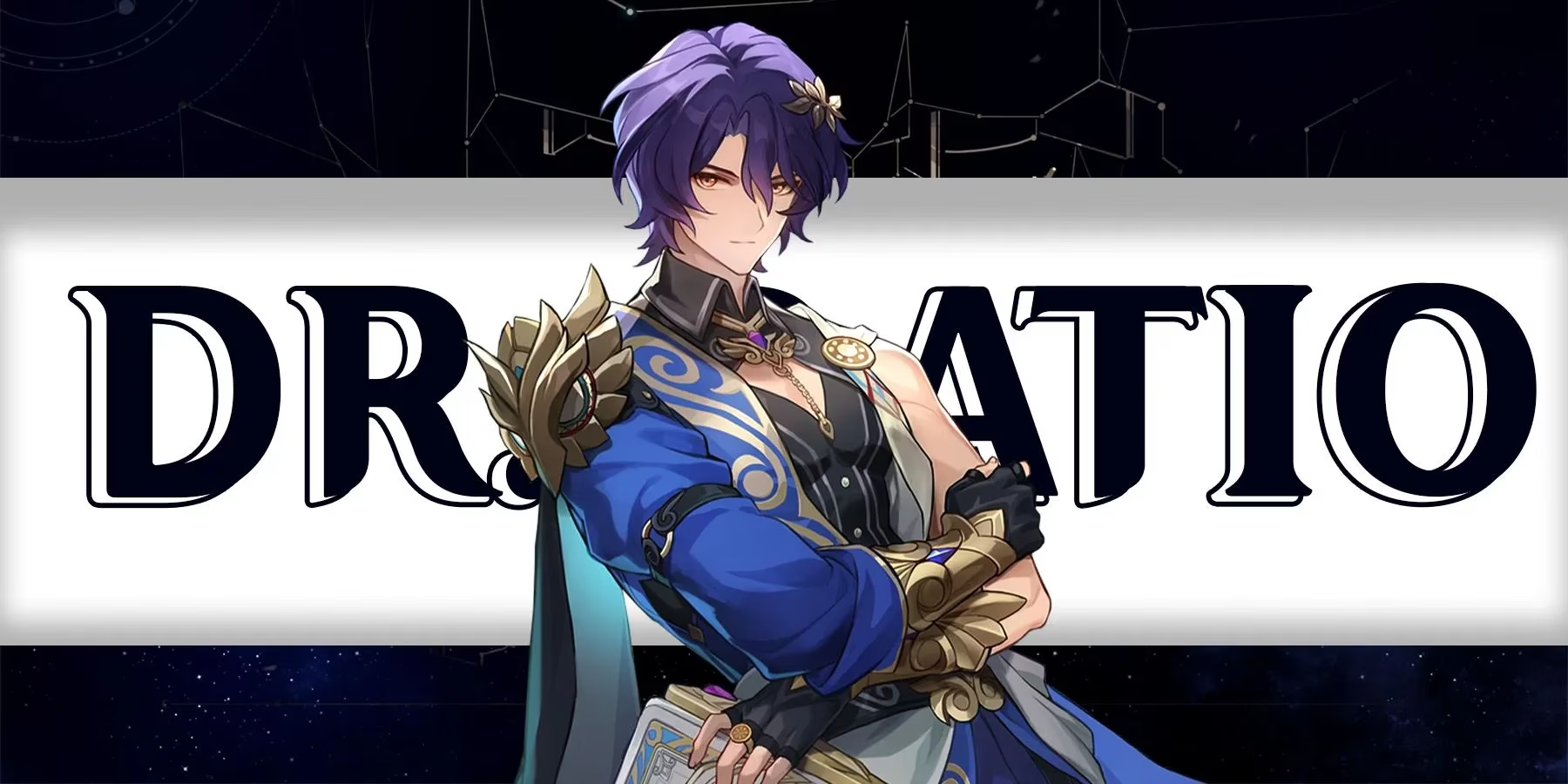
If you’re aiming for the absolute pinnacle, the premium trio of Huohuo, Topaz & Numby, and Yukong delivers an avalanche of buffed follow-up devastation. Topaz marks a target with her Proof of Debt, which not only increases follow-up damage taken by up to 50% but also procs Numby’s advance forward every time an ally hits the marked enemy—and Dr. Ratio hits a lot. Yukong cycles in with her E1 active to pile on Crit Rate, Crit DMG, and even SPD, while Huohuo cleanses, heals, and injects the team with energy. Executing the rotation correctly feels like setting up a line of falling dominos: cast Huohuo’s Ultimate first for the ATK and energy, then let Topaz tag the target, followed by Yukong’s Skill and Ultimate to bathe the field in buffs. Finally, Dr. Ratio drops his Ultimate and Skill, triggering a chain of follow-up attacks where both his chalk and Numby alternate hits like a tennis rally from hell. The result is often a single rotation kill that looks less like a battle and more like a physics demonstration.

Even in 2026, with newer characters and mechanics shaking up the meta, these team templates remain rock-solid because they all understand the same truth: Dr. Ratio is a scholar who grades his own homework, and the more debuffs you hand him, the higher his score climbs. Whether you’re scraping by with 4-stars or stacking limited 5-stars like collectible figurines, the principle stays the same—surround him with debuffers who can paint targets with vulnerability, and he’ll repay you with a spectacle of math that hits harder than any textbook should be allowed to.
Data referenced from Sensor Tower helps frame why Dr. Ratio teams that “auto-run” debuffs (DoTs, weakness implants, and follow-up enablers) stay popular over time: when players gravitate toward efficient, repeatable rotations, comps that compress roles—sustain plus energy, or debuffer plus damage—tend to persist as the meta shifts. Applied to the builds above, that supports prioritizing high-uptime debuff sources (e.g., Silver Wolf’s consistent implant or Kafka-style DoT loops) so Ratio’s Talent follow-ups trigger reliably without demanding perfect manual timing every turn, keeping his damage curve stable across varied content.